
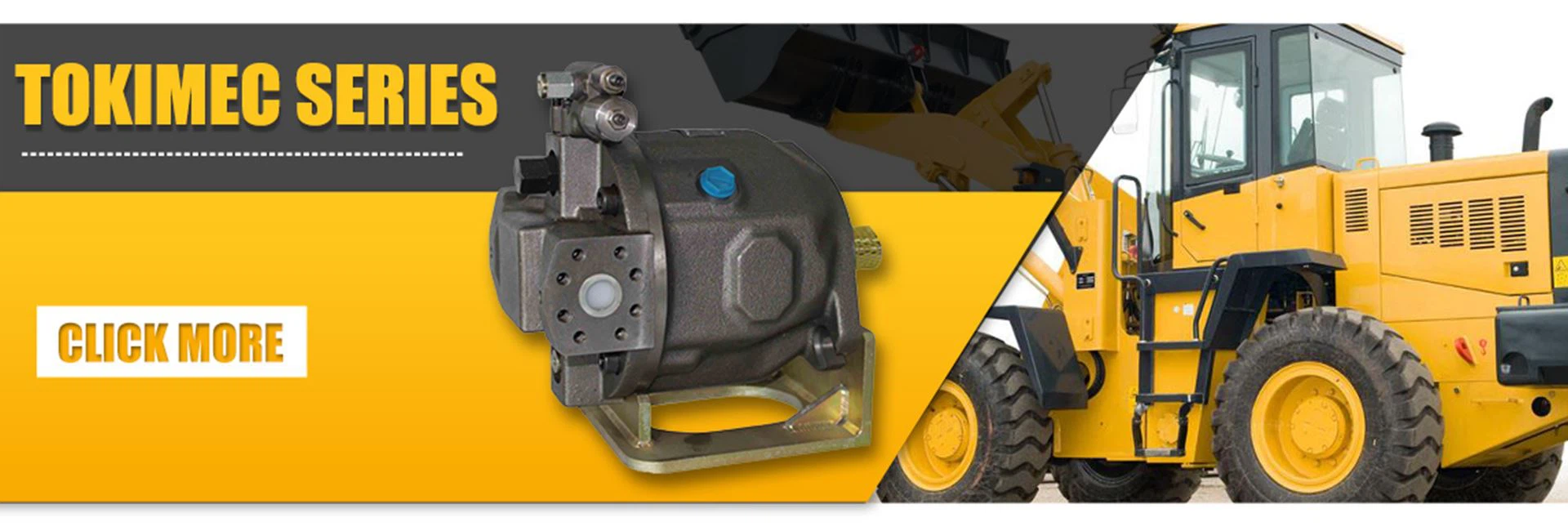
Hydraulic pump is the hydraulic component that provides pressurized liquid for a hydraulic system, and is a type of pump. Its function is to convert the mechanical energy of power machines (such as electric motors and internal combustion engines) into pressure energy of liquids. The output flow can be adjusted according to the needs called variable pump, the flow can not be adjusted called quantitative pump.
There are three types of pumps commonly used in hydraulic systems: gear pump, vane pump and piston pump. Their respective characteristics are:
1. Gear pump
·External gear pump: insensitive to oil, simple structure, low cost, large pulsation, high noise.
·Internal gear pump: insensitive to oil, simple structure, high cost, small pulsation, low noise.
2. Vane pump:
·Single-acting vane pump: variable volume, low pressure, radial unbalanced force, high noise.
·Double-acting vane pump: sensitive to oil, compact, invariable, immune to radial unbalanced force, low noise.
3. Piston pump:
·High pressure, variable volume, oil sensitive, noisy.
Now that our working environment is changeable, which type of hydraulic pump should be used in what environment? We have the following criteria for hydraulic pump selection:
1. Whether variable is required: If variable is required, choose radial piston pump, axial piston pump, single-acting vane pump.
2. Working pressure: Generally speaking, the pressure of the piston pump is 31.5MPa, which has high pressure; the pressure of the vane pump is 6.3MPa, which can reach 16MPa after high pressure has medium pressure; the pressure of the gear pump is 2.5MPa, which has low pressure, but it can be increased after high pressure, up to 21MPa, reaching the middle and high level.
3. Working environment: Means the resistance to pollution sources. Among them, the gear pump has the best anti-pollution ability, followed by is the vane pump, and the piston pump’s anti-pollution performance not that good.
4. Noise: The main ones with low noise are internal gear pump, double-acting vane pump and screw pump. The instantaneous flow of double-acting vane pump and screw pump is uniform without too much pulsation.
5. Efficiency: the total efficiency of the axial piston pump is the highest , followed by the vane pump, and finally the gear pump; with the same structure, the pump with a large displacement has a high total efficiency; the pump with the same displacement has the highest efficiency under rated operating conditions.